
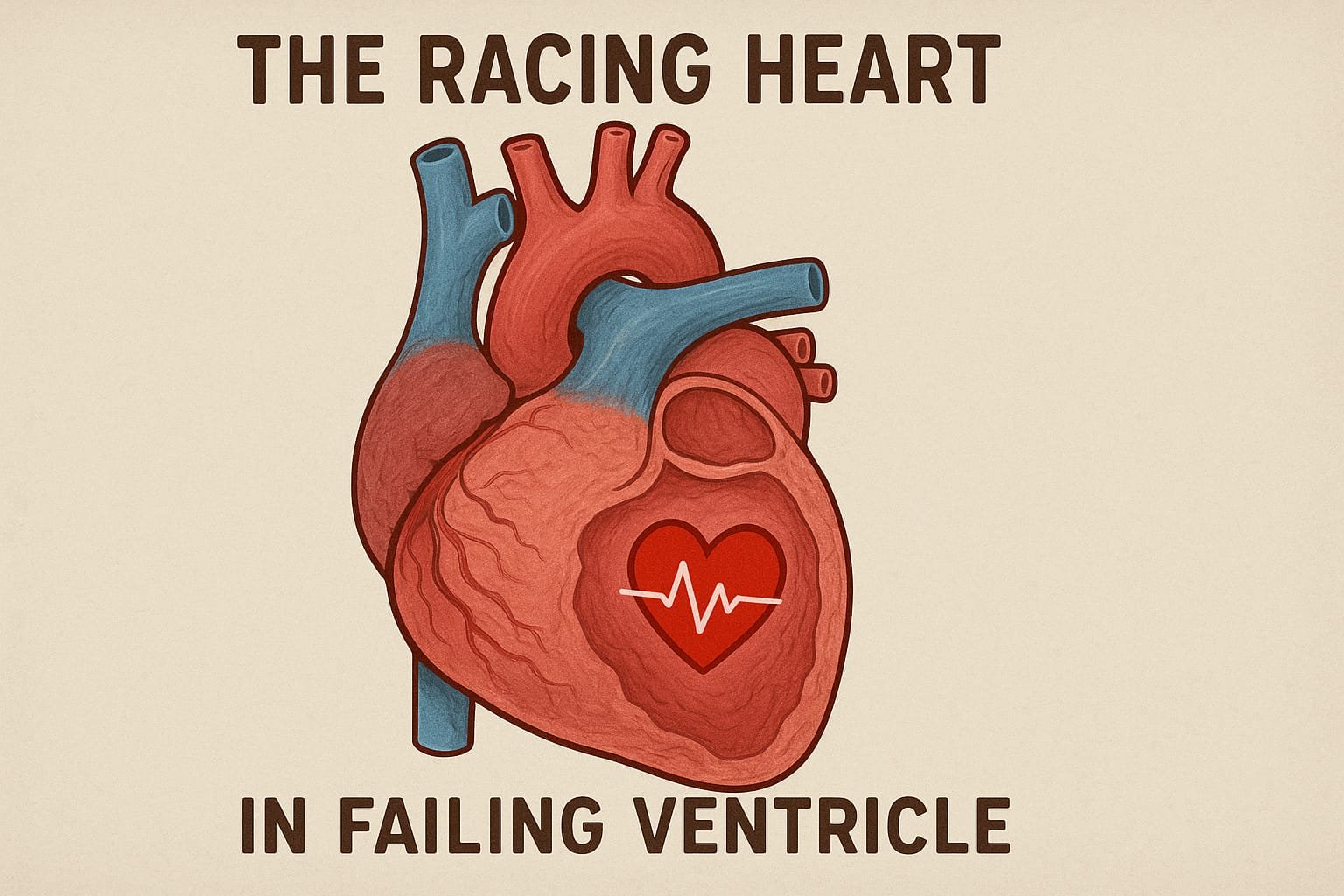
The Racing Heart in Failing Ventricle
1) Diagnosis
- Acute Left Ventricular Failure (LVF)
- Atrial Fibrillation (AF) with Rapid Ventricular Response (RVR)
2) History of Present Illness (HPI)
- A 68-year-old female presented to the ER with acute shortness of breath, worsening over 3 days. She reported: Orthopnea and paroxysmal nocturnal dyspnea. Palpitations, fatigue. No chest pain, syncope, or fever.
3) Past Medical History
- Hypertension × 12 years → on Amlodipine 5 mg OD (Ca²⁺ channel blocker → vasodilation).
- Diabetes Mellitus Type 2 × 8 years → on Metformin 500 mg BD (↓ hepatic gluconeogenesis, ↑ insulin sensitivity).
- Ischemic Heart Disease × 3 years → on Ecosprin 75 mg OD (antiplatelet, COX-1 inhibition).
4) Physical Examination
- Patient in respiratory distress, sitting upright, speaking in broken sentences.
- Respiratory: Bibasal crepitations + expiratory wheeze.
- CVS: Irregularly irregular rhythm, no murmurs.
- Extremities: Pedal edema present.
5) Vitals on Admission
- HR: 140/min, irregularly irregular
- BP: 90/60 mmHg
- RR: 36/min
- Temp: afebrile
- SpO₂: 84% on room air (improved to 94% on O₂ mask)
- GCS: 15/15
6) Echocardiography (ECHO)
- LV: Dilated, EF ~30%, global hypokinesia
- LA: Dilated
- Valves: Mild MR, no significant AR
- RV: Normal
- No LV thrombus or pericardial effusion
7) Investigations
- Baseline (Day 0 — Admission)
- CBC: Hb 10.2 g/dL, WBC 12.4×10⁹/L, Plt 230×10⁹/L
- Mild anemia worsens dyspnea; leukocytosis may be stress vs infection.
- RFT: Urea 58 mg/dL, Creatinine 1.6 mg/dL (eGFR ≈ 42)
- Congestion/prerenal picture; guides diuretics & digoxin dosing.
- Electrolytes: Na 130 mmol/L, K 3.4 mmol/L, Mg 1.6 mg/dL
- Hyponatremia = marker of severe HF; hypokalemia/hypomagnesemia ↑ arrhythmia risk.
- LFTs: TBili 1.4 mg/dL, AST/ALT 62/58 U/L
- Mild congestive hepatopathy.
- ABG (on NRBM): pH 7.47, PaO₂ 58 mmHg, PaCO₂ 32 mmHg, HCO₃⁻ 22 mEq/L, SaO₂ 86%
- Type I respiratory failure, respiratory alkalosis.
- NT-proBNP: 9,800 pg/mL (≫300 pg/mL rule-out threshold)
- Strongly supports acute HF.
- High-sensitivity Troponin I: 10 ng/L (99th ULN = 16)
- Negative; ACS less likely trigger.
- Thyroid panel (TSH): 0.9 mIU/L
- Normal, rules out thyrotoxic AF.
- Inflammatory markers: CRP 8 mg/L, PCT 0.12 ng/mL
- Low → bacterial infection unlikely.
- Coagulation: INR 1.0, aPTT 32 s
- Safe baseline before anticoagulation.
- Lactate: 1.8 mmol/L
- No tissue hypoperfusion.
Follow-up / Day-wise Trends
| Test | Day 0 | Day 1 | Day 2 | Day 3 | Comment |
| Na (mmol/L) | 130 | 134 | 136 | 137 | Improves with diuresis & fluid restriction |
| K (mmol/L) | 3.4 | 3.9 | 4.1 | 4.2 | Corrected to safe range for AF |
| Creatinine (mg/dL) | 1.6 | 1.5 | 1.4 | 1.3 | Stable/improving renal function |
| ABG PaO₂ (mmHg) | 58 | 78 (on NIV) | 88 (on NC) | 92 (on NC) | Oxygenation improves |
| NT-proBNP (pg/mL) | 9800 | – | 6200 | 4100 | Downtrend = decongestion |
| CRP (mg/L) | 8 | 7 | 6 | 5 | No infection |
| Digoxin (ng/mL) | – | – | – | 0.6 | Within HF therapeutic range (0.5–0.9) |
8) Chest X-Ray:-
- Cardiomegaly
- Pulmonary venous congestion
- Bilateral perihilar opacities (“bat wing” pattern)
- Classic pulmonary edema appearance.
9) ECG & RBS
- ECG: AF with RVR (irregularly irregular, absent P waves, narrow QRS).
- RBS: 180 mg/dL.
10) Emergency Stabilization (Day 0 in ER)
- Airway/Breathing: O₂ via NRBM → escalated to NIV (BiPAP).
- Circulation: IV line, strict fluid restriction.
- Drugs:
- Inj. Furosemide 40 mg IV stat (preload reduction).
- Noradrenaline infusion (0.05 mcg/kg/min) for hypotension.
- Digoxin 0.25 mg IV (rate control in AF + hypotension).
- Morphine 2 mg IV slow (↓ preload, anxiolysis)
11) ICU Day-by-Day Care
- Day 1
- On NIV, SpO₂ improved to 95%.
- IV Lasix repeated.
- Digoxin loading completed (0.75 mg/24h).
- Started Enoxaparin 60 mg SC BD (anticoagulation).
- Hyponatremia noted (Na 130).
- Day 2
- SpO₂ 96% on NIV.
- Urine output 2.5 L/24h.
- HR ↓ to 110/min.
- Noradrenaline tapered.
- Started nebulizations (Duolin + Budecort).
- Oral diuretics added (Tab Furosemide 40 mg BD).
- Day 3
- Shifted from NIV → nasal cannula.
- HR stabilized at 90–100/min.
- Switched Digoxin to oral (0.125 mg OD).
- Started Enalapril 2.5 mg BD (ACEi).
- Fluid & salt restriction reinforced.
12) Discharge Medicines
- Tab Furosemide 40 mg BD – loop diuretic.
- Tab Spironolactone 25 mg OD – aldosterone antagonist.
- Tab Digoxin 0.125 mg OD – AV nodal blocking, positive inotrope.
- Tab Enalapril 2.5 mg BD – afterload reduction, mortality benefit.
- Tab Atorvastatin 20 mg HS – CAD prevention.
- Tab Acenocoumarol 2 mg OD – anticoagulation (INR target 2–3).
13) Key Notes / Pearls
- LVF + AF = vicious cycle → tachyarrhythmia worsens filling → pulmonary edema worsens.
- Digoxin = preferred for rate control in AF with hypotension.
- Anticoagulation mandatory if CHA₂DS₂-VASc ≥ 2.
- Always monitor renal function & electrolytes on diuretics/digoxin.
- ECHO early is crucial for prognosis & management guidance.
14) Comparison Table – LVF vs AF
| Feature | LVF | AF | OVERLAP |
| Symptoms | Dyspnea, orthopnea, PND | Palpitations, fatigue | Breathlessness + palpitations |
| Pulse | Tachycardia, weak | Irregularly irregular | Pulse deficit worsens |
| Auscultation | Crepitations, S3 | Irregular heart sounds | Crackles + chaos |
| BP | Often low | Variable | AF worsens hypotension |
| ECG | LV strain/ischemia | No P waves, irregular | AF masks ischemic signs |
| ECHO | ↓ EF, LV dilated | LA dilated | Both findings together |
| CXR | Pulmonary edema | Normal | LVF findings dominate |
| Risk | Pulmonary edema | Stroke | Stroke + HF decompensation |
15) Case Storytelling
She arrived gasping, pulse racing irregularly — a storm within a failing ventricle. The X-ray showed drowning lungs, ECHO a heart too weak to pump. Each intervention — oxygen, diuretics, digoxin — pulled her back from the edge. By Day 3, the rhythm calmed, lungs cleared, and she whispered, “I can breathe again.” This case reminded us how quickly LVF and AF spiral, and how decisive ICU care can save a life.