
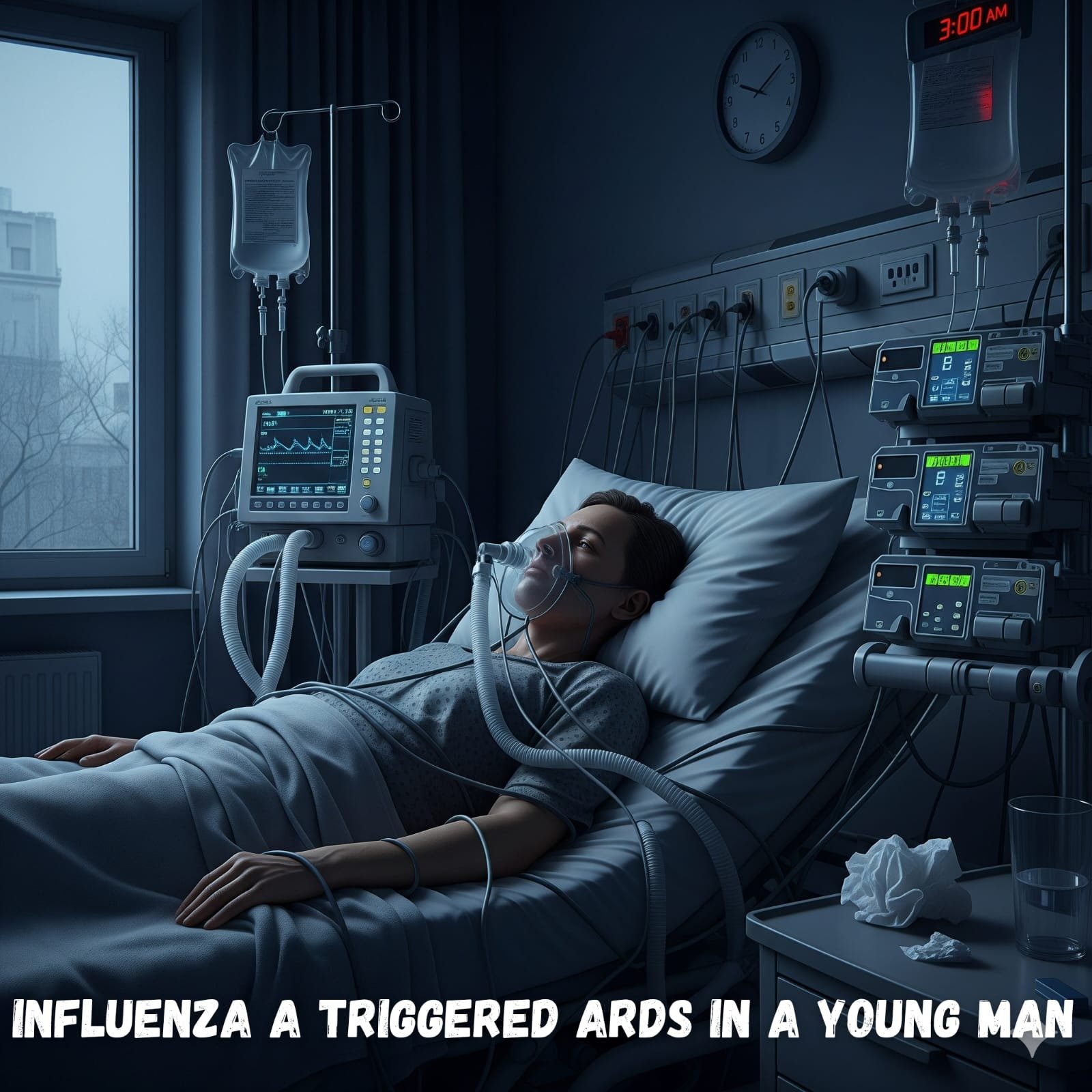
Influenza A Triggered ARDS in a Young Man
1) Unique Case Name
- “The Flu That Silenced the Lungs”
2) Diagnosis
- Primary: Severe Acute Hypoxemic Respiratory Failure due to Influenza A (PCR positive)
- Secondary/Complications: Septic shock requiring vasopressors, Acute Kidney Injury (AKI) requiring CRRT, Severe ARDS.
3) History of Present Illness (HPI)
- Chief Complaint: High-grade fever, dry cough, progressive dyspnea for 5 days.
- Progression:
- Day 1–3: Fever, myalgia, sore throat, non-productive cough.
- Day 4: Worsening breathlessness, pleuritic chest pain.
- Day 5: Severe dyspnea, confusion → ER presentation.
- Associated Symptoms: Fatigue, chills, headache.
- Negative History: No aspiration, no trauma, no known COPD/asthma, no CAD/HTN/DM.
4) Past Medical History
- No chronic diseases, No prior surgeries or ICU admissions, No chronic medication use.
5) Physical Examination
- General: Ill-appearing, diaphoretic, accessory muscle use, drowsy.
- CVS: Tachycardia, cold peripheries, no murmurs.
- RS: Diffuse bilateral crackles, reduced air entry.
- CNS: GCS E3V4M5, drowsy but arousable.
- Abdomen: Soft, non-tender.
6) Vitals on Admission
- HR: 124/min
- BP: 88/56 mmHg
- RR: 36/min
- Temp: 39.4°C
- SpO₂: 78% (room air)
- GCS: 12/15
7) Echocardiography (ECHO)
- LV: Normal size, EF 55%
- No wall motion abnormality
- Valves: Normal
- No pericardial effusion
8) Investigations
- Baseline (Day 0):
- CBC: Hb 13.2, WBC 3,200 (lymphopenia), Plt 180k
- RFT: Urea 62, Creat 2.1 (AKI evolving)
- Electrolytes: Na 130, K 4.9
- LFT: AST 55, ALT 62, Bil 1.4
- ABG: PaO₂ 48, PaCO₂ 62, pH 7.24 → Type I + Type II failure
- CRP: 165 mg/L, Ferritin ↑
- Troponin I: Negative
- Coagulation: INR 1.3, aPTT 32
- Lactate: 3.6 mmol/L
- RT-PCR: Influenza A positive, COVID-19 negative
- Follow-up Trends:
| Day | Na | K | Creat | PaO₂/FiO₂ | CRP | Lactate |
| 0 | 130 | 4.9 | 2.1 | 90 | 165 | 3.6 |
| 1 | 132 | 4.7 | 2.5 | 100 | 150 | 2.9 |
| 2 | 135 | 4.3 | 2.2 | 140 | 120 | 2.0 |
| 3 | 137 | 4.2 | 1.8 | 180 | 80 | 1.4 |
9) Imaging
- Chest X-ray (Day 0): Bilateral diffuse infiltrates, “white-out” ARDS.
- HRCT Chest: Diffuse ground-glass opacities with patchy consolidation
10) ECG & RBS
- ECG: Sinus tachycardia, no ischemic changes.
- RBS: 112 mg/dL.
11) Emergency Stabilization (Day 0 – ER)
- Airway/Breathing: Intubated for impending respiratory arrest. Ventilation: ARDS protocol (TV 6 mL/kg PBW, PEEP 12–14, FiO₂ 1.0).
- Circulation: Fluids cautiously, norepinephrine infusion started.
- Drugs:
- Oseltamivir 75 mg via Ryle’s (antiviral)
- Piperacillin-Tazobactam IV (empiric antibiotics)
- Paracetamol IV (fever control)
- Sedation: Midazolam + Fentanyl, paralysis for ventilator synchrony
12) Day-by-Day ICU Care
- Day 1:
- Severe ARDS, PaO₂/FiO₂ 90.
- First prone positioning (16 hrs).
- CRRT initiated for AKI + fluid overload.
- Norepinephrine 0.25 μg/kg/min.
- Day 2:
- Still severe ARDS, FiO₂ 0.8, PaO₂/FiO₂ < 100.
- Second prone session.
- Hemodynamics improving (MAP > 65, NE 0.15 μg/kg/min).
- Lactate ↓ to 2.9.
- Day 3:
- PaO₂/FiO₂ = 140, FiO₂ reduced to 0.6.
- Norepinephrine tapered (0.08 μg/kg/min).
- Urine output ↑, CRRT continued.
- Cultures negative → antibiotics de-escalated.
- Day 4:
- Oxygenation improving (PaO₂/FiO₂ 180), FiO₂ 0.5, PEEP 10.
- Off vasopressors.
- CRRT discontinued, UO > 1 mL/kg/hr.
- Sedation breaks initiated.
- Day 5–6:
- FiO₂ 0.4, PEEP 8, stable hemodynamics.
- Awake on light sedation, follows commands.
- Weaning trials started.
- Day 7:
- Successful extubation to HFNC (FiO₂ 0.4, 50 L/min).
- SpO₂ maintained > 95%.
- Started physiotherapy & incentive spirometry.
- Day 8–10:
- Weaned from HFNC → nasal cannula.
- Oral feeding started, Ryle’s removed.
- Mobilization with assistance.
- Day 12 – Discharge:
- Ambulating, SpO₂ 97% RA, creatinine 1.1.
- Completed 10-day oseltamivir course.
- Discharge advice: Annual influenza vaccination.
13) Discharge Medicines
- Completed Oseltamivir course
- Multivitamins
- Nebulizers (Levosalbutamol + Budesonide PRN)
14) Key Notes / Clinical Pearls
- Influenza A can cause life-threatening ARDS in healthy adults.
- Early intubation + ARDS ventilation + prone positioning are lifesaving.
- CRRT helps manage fluid overload and cytokine surge in ARDS with AKI.
- Oseltamivir is beneficial even beyond 48 hrs in ICU patients.
- Always consider secondary bacterial pneumonia.
15) Case Storytelling
“A 38-year-old software engineer walked into the ER gasping for air, thinking it was ‘just flu.’ Within hours, he was sedated, ventilated, and fighting ARDS caused by Influenza A. Machines breathed for him, filters cleaned his blood, and his family stood praying outside. On Day 7, he opened his eyes, extubated, whispering weakly — ‘I thought flu was harmless…’ By Day 12, he walked out alive, teaching us that even a simple virus can silence healthy lungs.”
16) MCQ Q&A Section
- Q1. What is the defining ABG pattern in ARDS?
Ans: Severe hypoxemia with PaO₂/FiO₂ < 300; here, <100 = severe ARDS. - Q2. What ventilatory strategy improves survival in ARDS?
Ans: Low tidal volume (6 mL/kg PBW), high PEEP, prone positioning. - Q3. Why use Oseltamivir beyond 48 hrs in ICU influenza?
Ans: Critical patients still benefit from viral suppression. - Q4. What lab finding suggests viral etiology in influenza pneumonia?
Ans: Lymphopenia with high CRP. - Q5. What is the most common complication of severe influenza A in ICU?
Ans: ARDS + secondary bacterial pneumonia.