
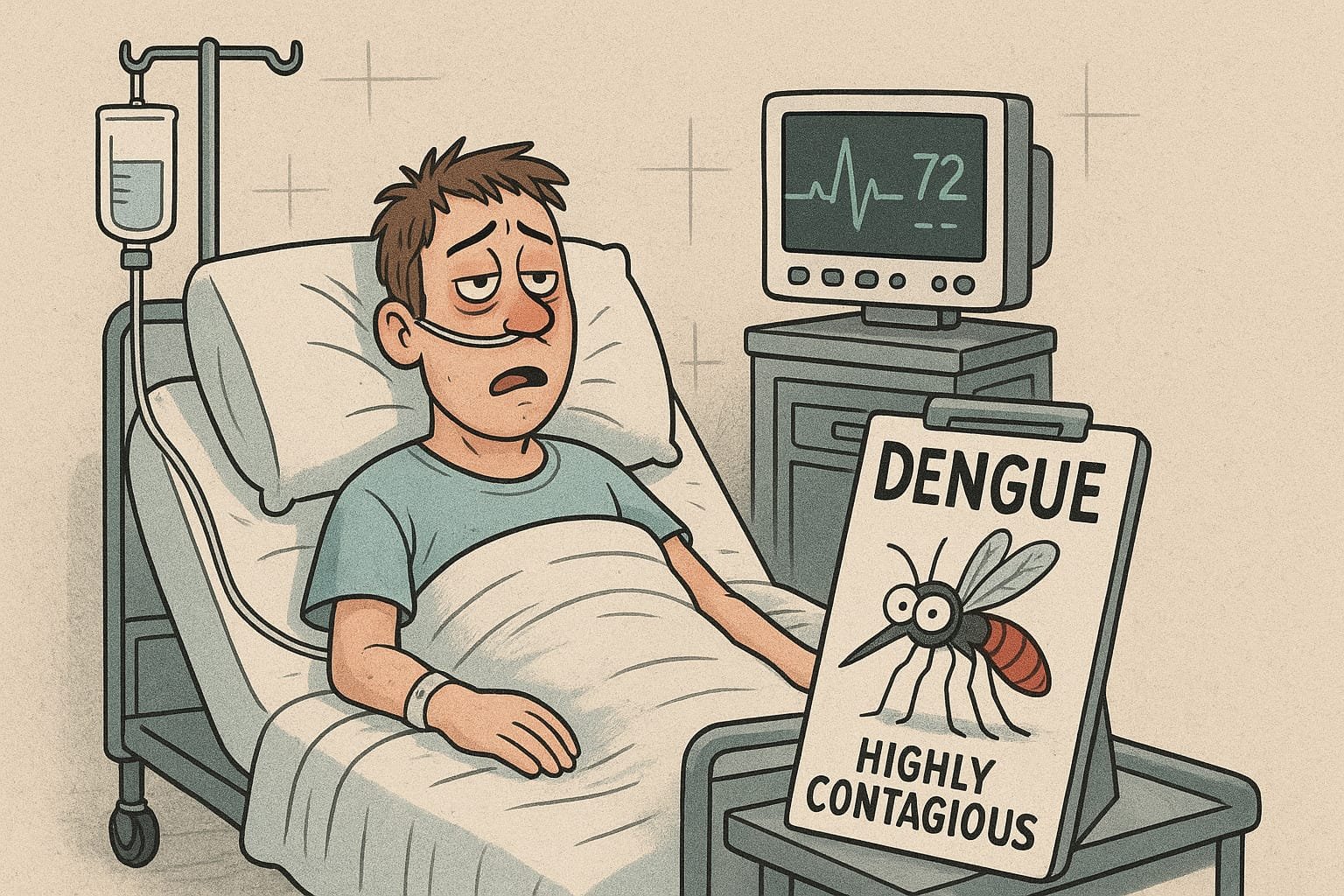
Hemorrhagic Dengue with Shock
History of Present Illness
- Mr. R, a 32-year-old male, presented with high-grade fever for 5 days, associated with severe retro-orbital headache, myalgia, and generalized body ache. On Day 4 of fever: developed abdominal pain, nausea, and persistent vomiting. On Day 5 morning: he noticed bleeding gums and a few petechiae on both legs.
- On arrival to ER: fever had subsided (defervescence phase) but patient complained of dizziness, abdominal pain, and reduced urine output.
Past Medical History
- Hypertension × 3 years – controlled with Amlodipine 5 mg once daily.
- Mechanism: Amlodipine is a calcium channel blocker (DHP type) → causes vasodilation of arterioles → lowers systemic vascular resistance → reduces BP.
- No diabetes, CKD, ischemic heart disease, asthma, or bleeding disorders.
- No known drug allergies.
- No anticoagulant or NSAID use.
On Examination (ICU Admission, Day 1 Critical Phase)
- General: Anxious, restless, cold extremities, petechial rash on both legs.
- Vitals:
- Temp: Afebrile
- HR: 128/min (tachycardia)
- BP: 90/70 mmHg (narrow pulse pressure = 20 mmHg)
- RR: 30/min (tachypnea)
- SpO₂: 95% on room air
- Systemic Exam:
- CVS: Tachycardia, weak pulse
- RS: Clear, no crepitations
- Abdomen: Tender hepatomegaly, ascites (shifting dullness + confirmed on USG)
- CNS: Conscious, oriented
Investigations on Admission (Day 1)
| Test | Result | Interpretation |
| Hb | 14 g/dL | Normal |
| HCT | 49% (baseline 38%) | ↑ Hemoconcentration → plasma leakage |
| WBC | 3,200/µL | Leukopenia, typical of viral infection |
| Platelets | 36,000/µL | Severe thrombocytopenia |
| AST/ALT | AST 480 ALT 300 | Dengue hepatitis (AST > ALT) |
| Creatinine | 1.1 mg/dL | Borderline, watch renal perfusion |
| Na/K | Na 132 K 3.3 | Mild hyponatremia, hypokalemia (vomiting + fluid shifts) |
| INR | 1.5 Mild | coagulopathy |
| ABG | pH 7.32, HCO₃ 18 | Metabolic acidosis due to hypo perfusion |
| USG Abdomen | Mild ascites, GB wall edema | Plasma leak evidence |
| CXR | Normal lungs | No effusion initially |
Initial ICU Management (Day 1)
- Airway/Breathing: Oxygen by nasal cannula 3 L/min → maintain SpO₂ >94%.
- Circulation:
- IV access (2 large bore + central line).
- Started Ringer Lactate at 7 mL/kg/hr (≈ 350 mL/hr for 50 kg).
- Why RL? Balanced crystalloids preferred over NS (less hyperchloremic acidosis).
- Why 7 mL/kg/hr? WHO recommends 5–7 mL/kg/hr during plasma leakage phase.
- Foley catheter: Strict urine monitoring → goal >0.5 mL/kg/hr.
- Investigations ordered: CBC & HCT q6h, ABG q12h, daily LFT/RFT.
- Drugs avoided: NSAIDs, IM injections, steroids.
- Transfusion policy explained: No prophylactic platelet transfusion unless <10k with bleeding or <20k with major risk/procedure.
Day 2 – Shock Worsening
- Overnight Events: Patient restless, hypotensive.
- Vitals: HR 142, BP 80/60 (PP 20), urine 15 mL/hr, SpO₂ 92%.
- Labs: HCT 55% (still rising → ongoing plasma leak), Platelets 24k, Lactate 3.4.
- CXR: New bilateral pleural effusion.
- Management:
- NS bolus 10 mL/kg over 1 hr (fluid responsive).
- Still hypotensive → Dextran 40 10 mL/kg over 1 hr (colloid for refractory shock).
- Started Noradrenaline 0.1 µg/kg/min (MAP target >65 mmHg).
- Corrected hypokalemia with IV KCl.
- No platelet transfusion (only mucosal bleed, stable Hb).
- Rationale: Shock due to plasma leakage, not bleeding → fluids + vasopressors more important.
Day 3 – Stabilization Phase
- Vitals: HR 110, BP 102/74, Urine output 40 mL/hr, extremities warm.
- Labs: HCT ↓ 46% (improving), Platelets 22k, Cr 1.0, Na 134.
- CXR: Stable pleural effusion, no pulmonary edema.
- Management:
- Reduced fluids → 5 mL/kg/hr (maintenance).
- Noradrenaline tapered gradually.
- Nutrition: Started NG tube feeding (100 mL every 3 hr).
- Prophylaxis: IV pantoprazole for stress ulcer, DVT stockings (no LMWH because of thrombocytopenia).
- Physiotherapy: Chest & limb exercises.
- Monitoring: CBC & HCT q12h.
Day 4 – Recovery Phase
- Vitals: HR 98, BP 110/76, urine 2 mL/kg/hr (polyuric).
- Labs: HCT 42% (normalizing), Platelets 28k (rising), Cr 0.9, AST/ALT trending down.
- Clinical: More alert, less abdominal pain.
- Management:
- Reduced IV fluids → 2 mL/kg/hr (avoid overload during reabsorption).
- Noradrenaline stopped.
- Switched to oral hydration + soft diet.
- Monitoring for pulmonary edema → daily lung auscultation + bedside USG.
Day 5 – Transfer Ready
- Vitals: HR 92, BP 112/78, SpO₂ 98% RA, afebrile, tolerating diet.
- Labs: HCT 38% (normal), Platelets 52k, LFT/RFT improving, CXR effusion resolving.
- Management:
- IV fluids stopped completely → oral hydration only.
- Mobilized out of bed.
- CBC once daily in ward.
- No platelet transfusion.
- Handover to ward with advice for discharge once platelets >100k and clinically stable.
Summary of Pathophysiology Across ICU Stay
- Day 1 & 2: Plasma leakage → hemoconcentration, shock.
- Day 3: Stabilization → fluids carefully titrated, vasopressors tapered.
- Day 4: Recovery → reabsorption phase, risk of pulmonary edema.
- Day 5: Recovery complete → safe transfer