
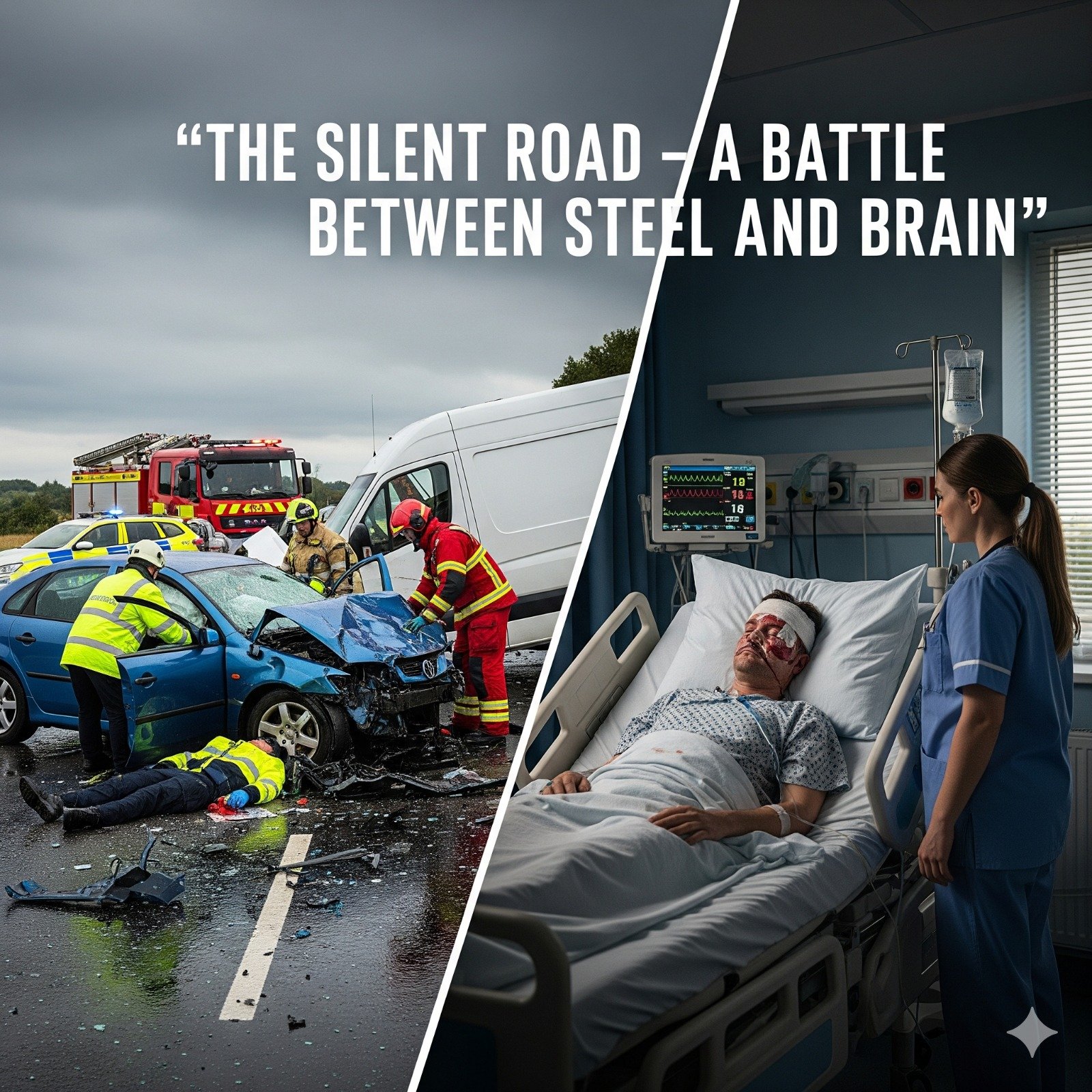
The Silent Road – A Battle Between Steel and Brain
1) Diagnosis
- Primary: Severe Head Injury with Altered Sensorium (GCS 8/15)
- Secondary: Multiple Soft Tissue Injuries, Left Rib Fractures (4th–6th ribs)
2) History of Present Illness (HPI)
- Chief Complaint: Found unconscious at roadside after high-speed motorcycle accident, brought by bystanders.
- Duration: ~30 minutes post-trauma.
- Progression: No history available from patient (due to unconsciousness). Relatives deny seizures or prior illness.
- Associated Symptoms: Vomiting ×2 en route. No bleeding from ear/nose reported.
- Negative History: No chest pain, no dyspnea prior to accident.
3) Past Medical History
- No known DM, HTN, CAD, COPD, CKD.
- No prior surgeries.
- No regular medications.
4) Physical Examination (on arrival to ER)
- General: Unconscious, bleeding abrasions on face, chest, forearm. Pallor +, Cyanosis −, Edema −.
- CVS: S1 S2 normal, no murmur.
- RS: Decreased breath sounds left basal zone, tenderness over ribs.
- CNS: GCS 8/15 (E2 V2 M4). Pupils: equal, sluggish reaction.
- Abdomen: Soft, no guarding/rigidity.
5) Vitals on Admission
- HR: 122/min (tachycardia) BP: 90/60 mmHg (hypotension – shock)
- RR: 28/min (tachypnea) Temp: 99.2°F
- SpO₂: 86% RA → 94% with O₂ NRBM GCS: 8/15
6) Investigations
- Day 0 (ER):
- CBC: Hb 11 g/dL, WBC 14,500/µL, Platelets 1.6 lakh/µL
- RFT: Creatinine 1.2 mg/Dl
- Electrolytes: Na 134, K 3.8 mmol/L
- ABG: PaO₂ 58 mmHg, PaCO₂ 52 mmHg, pH 7.28 → Type II respiratory failure
- CT Brain: Small right temporal contusion + diffuse cerebral edema, no midline shift.
- CXR: Left rib fracture 4–6 with mild hemothorax.
- FAST (USG): No intra-abdominal bleed.
7) Day 0 (Emergency Room & ICU Admission)
- Presentation: Unconscious, brought 30 min post-RTA. Vomited ×2.
- Vitals: HR 122, BP 90/60, RR 28, SpO₂ 86% (RA), Temp 99.2°F, GCS 8/15.
- Exam: Pupils equal, sluggish. Left chest tenderness with crepitus. Multiple abrasions. No abdominal guarding.
- ABG: pH 7.28, PaO₂ 58, PaCO₂ 52 → Type II respiratory failure.
- CXR: Left 4th–6th rib fractures + moderate hemothorax.
- CT Brain: Right temporal contusion + diffuse cerebral edema, no midline shift.
- FAST: Negative.
- Interventions:
- Intubation with ETT 8.0, ventilated (SIMV: TV 450 mL, FiO₂ 50%, PEEP 5).
- Fluid resuscitation: NS 1L bolus.
- Noradrenaline infusion 0.1 µg/kg/min for MAP > 65.
- Mannitol 20% 100 mL IV over 30 min.
- Levetiracetam 1 g IV stat.
- Ceftriaxone 2 g IV.
- Tranexamic acid 1 g IV over 10 min.
- Analgesia: Fentanyl 100 µg bolus → infusion 25 µg/hr + Midazolam 2 mg/hr.
- Left intercostal chest tube inserted → 350 mL blood drained.
8) Day-by-Day ICU
- Day 1 (ICU)
- Vitals: BP 100/70 (Norad 0.08), HR 110, SpO₂ 96% (FiO₂ 40%), Temp 99°F.
- GCS: 8/15 (sedated).
- Chest tube: total drainage 450 mL.
- UO: 1.1 L/24h.
- ABG: PaO₂ 78, PaCO₂ 48, pH 7.32.
- Labs: Hb 10.8, WBC 14k, Plt 1.5 lakh. Cr 1.1, Na 136, K 3.9.
- Treatment:
- Continued ventilation (SIMV, TV 450, FiO₂ 40%, PEEP 5).
- Norad maintained.
- Mannitol 100 mL 8-hourly.
- Levetiracetam 500 mg BD IV.
- DVT prophylaxis: compression stockings (pharmacological deferred).
- Nutrition: NPO, IV fluids (DNS + NS).
- Day 2 (ICU)
- Vitals: BP 108/72 (Norad 0.05), HR 102, SpO₂ 97% (FiO₂ 35%).
- GCS: 9/15 (E3 V2 M4) when sedation interrupted.
- Chest tube: drained 50 mL serosanguinous.
- ABG: PaO₂ 82, PaCO₂ 46, pH 7.35.
- Labs: Na 138, K 4.0, Cr 1.0.
- Treatment:
- Sedation lightened (Midazolam tapered, Fentanyl continued).
- Ventilator: SIMV → PS mode trial for 2h tolerated.
- Started Ryle’s tube feeding (Osmolite 50 mL/hr).
- Antibiotics escalated to Piperacillin-Tazobactam 4.5 g IV TDS (raised WBC).
- Chest physiotherapy + incentive spirometry attempted.
- Day 3 (ICU)
- Vitals: BP 112/74 (off Norad), HR 96, SpO₂ 98% (FiO₂ 30%).
- GCS: 10/15 (E3 V2 M5).
- Neuro: Pupils equal, sluggish. No lateralizing signs.
- Chest tube: minimal output, lung expansion good on CXR.
- ABG: PaO₂ 90, PaCO₂ 42, pH 7.37.
- Treatment:
- Norad stopped.
- Ventilation: PSV 12, PEEP 5, FiO₂ 30%.
- Chest tube clamped for trial.
- Continued Mannitol 100 mL q8h.
- Feeds increased to 100 mL/hr.
- Started Pantoprazole 40 mg IV OD for stress ulcer prophylaxis.
- Day 4 (ICU – Weaning)
- Vitals: BP 116/76, HR 92, SpO₂ 99% (FiO₂ 28%).
- GCS: 11/15 (E4 V2 M5).
- Neuro: Opens eyes spontaneously, localizes pain.
- ABG: PaO₂ 95, PaCO₂ 40, pH 7.39.
- CXR: good expansion, chest tube removed.
- Treatment:
- Extubation trial → passed spontaneous breathing trial (SBT).
- Successfully extubated, shifted to HFNC (FiO₂ 30%, 40 L/min).
- Analgesia: Paracetamol 1 g IV q8h + Tramadol SOS.
- Physiotherapy: active limb mobilization.
- Day 5 (Step-down)
- Vitals: HR 88, BP 118/76, SpO₂ 98% RA, Temp 98.4°F.
- GCS: 13/15 (E4 V4 M5).
- Oral intake: Soft diet tolerated.
- Ambulated with assistance.
- Wound dressings changed.
- Treatment:
- Shifted from IV to oral meds:
- Levetiracetam 500 mg BD PO.
- Paracetamol 650 mg TDS PO.
- Pantoprazole 40 mg OD PO.
- Chest physiotherapy continued.
- Shifted from IV to oral meds:
- Day 6–7 (Ward)
- Vitals: stable.
- GCS:14/15 (E4 V4 M6).
- Mild headache, no focal deficit.
- Stitches over abrasions healing.
- Discharge Plan:
- Levetiracetam 500 mg BD × 3 months
- Paracetamol SOS
- Physiotherapy follow-up
- Neurosurgery + trauma clinic review in 2 weeks
9) Key Clinical Pearls
- Early airway protection is life-saving in head trauma (GCS ≤ 8).
- Always look beyond head injury → chest, abdomen, bones.
- ICP management (Mannitol, head elevation, normocapnia) is critical.
- Day-by-day trend monitoring (ABG, electrolytes, GCS) helps guide weaning.
10) Storytelling Narrative
He was found unconscious on the roadside, his helmet shattered, his breaths shallow. In the ICU, machines breathed for him while his brain fought swelling and silence. Each day, his eyes opened a little wider, his lungs held a little longer. By the fifth day, he whispered — Doctor, can I call my mother? — a moment louder than any monitor beep.
11) MCQ Section
- Q1: Intubation is indicated in TBI if GCS ≤ ?
Ans: 8 - Q2: Best initial imaging in polytrauma with altered sensorium?
Ans: CT Brain - Q3: Drug of choice for seizure prophylaxis in TBI?
Ans: Levetiracetam