
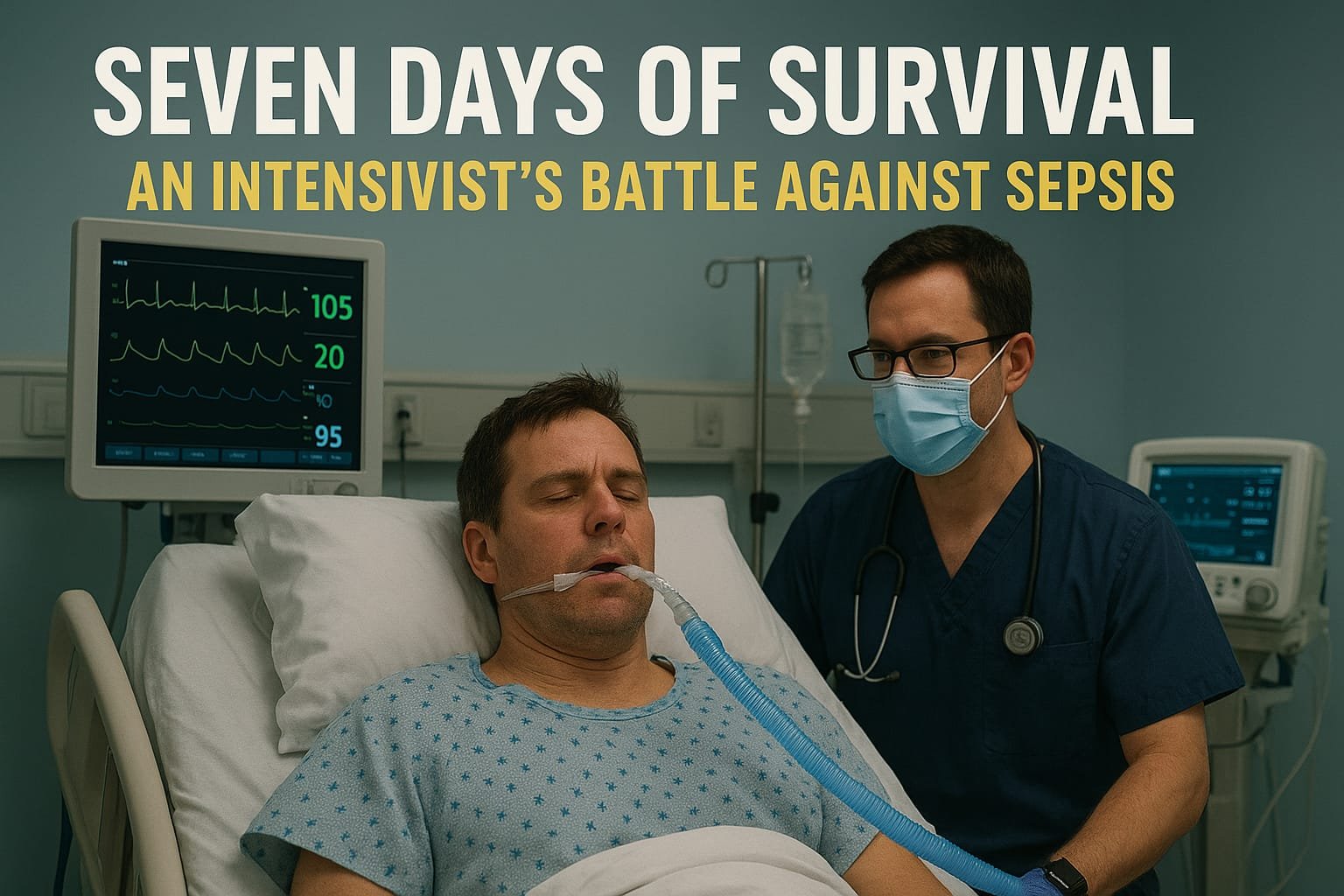
Septic Shock with AKI on CKD, Hepatic Encephalopathy & Uncontrolled Diabetes
Case Presentation
A 62-year-old male presented to the ICU with fever, altered sensorium, hypotension, and reduced urine output for 24 hours.
Past Medical History
- Type 2 Diabetes Mellitus – 15 years, uncontrolled (HbA1c 9.8%).
- CKD stage 4 – baseline Cr 3.2 mg/dL.
- Hypertension – 20 years.
- Alcoholic liver disease – with prior variceal bleed.
Past Medical History
Septic shock with AKI (on CKD) + Hepatic encephalopathy (Grade II–III) + uncontrolled diabetes mellitus.
ICU Management (Day-wise with Symptomatic Treatment)
Day 1: Admission
- Airway/Breathing: Intubated (GCS 7), on volume-controlled ventilation.
- Circulation: Noradrenaline 0.2 mcg/kg/min started → MAP > 65 mmHg.
- Fluids: 30 mL/kg balanced crystalloids (judicious in CKD).
- Antibiotics: Piperacillin-tazobactam + Vancomycin (renal adjusted).
- Hepatic encephalopathy: Lactulose (30 mL q6h), Rifaximin.
- Glycemic control: Insulin infusion (target 140–180 mg/dL).
- Stress ulcer prophylaxis: IV Pantoprazole 40 mg BD.
- DVT prophylaxis: Compression stockings (anticoagulation withheld due to INR 1.8).
- Symptomatic: Paracetamol for fever, ondansetron PRN.
- Nutrition: Ryle’s tube started with trophic feeding (20 mL/hr).
- Physiotherapy: Passive limb physiotherapy.
- Monitoring: A-line, CVC, urine catheter.
- Investigations
- CBC: WBC 22,000. Hb 9.2. Plt 70,000.
- Renal: Urea 148, Cr 5.6.
- LFT: TB 4.8, INR 1.8.
- ABG: pH 7.28, HCO₃⁻ 16, Lactate 5.2.
Day 2 ICU
- Hemodynamics: Noradrenaline uptitrated (0.35 mcg/kg/min). Vasopressin added.
- Renal support: SLED initiated (hyperkalemia, worsening acidosis).
- Antibiotics: Continued.
- Symptomatic: Antipyretic, stool softeners, electrolyte correction.
- Nutrition: Renal-specific formula started at 20 mL/hr continuous.
- Investigations:
- WBC 20,500; Cr 6.2; INR 2.0; Lactate 4.8.
Day 3 ICU
- Persistent fever → Escalated antibiotics to Meropenem + Linezolid.
- Hepatic encephalopathy unchanged (drowsy, not following commands).
- Nebulization: Duolin TDS + Budesonide BD (to prevent ventilator-associated atelectasis).
- Paracetamol 1g IV for fever spikes.
- Nutrition increased to 30 mL/hr.
- Investigations:
- WBC 19,000; Cr 5.8; INR 2.2.
Day 4 ICU
- Vasopressors reducing.
- Blood culture: Klebsiella pneumoniae (ESBL+) → switched to Meropenem + Colistin.
- Renal: SLED repeated.
- GI: Lactulose + rifaximin continued. Pantoprazole continued.
- Bowel care: Added Cremaffin at night (constipation prevention).
- Other care: Air bed, chest physiotherapy, pressure sore prevention.
- Investigations:
- WBC 15,500; Cr 4.9; TB 5.0.
Day 5 ICU
- Noradrenaline tapering down (0.15 mcg/kg/min). Vasopressin stopped.
- Patient opening eyes to pain (GCS E3VtM4).
- Insulin infusion continued.
- Tube feeding advanced to 40 mL/hr.
- IV thiamine added (alcoholic liver disease).
- Investigations:
- WBC 13,000; Cr 4.2; Lactate 2.8.
Day 6 ICU
- Vasopressors off. Stable MAP.
- Hepatic encephalopathy improving (follows commands).
- Chest X-ray: infiltrates resolving.
- Extubation trial attempted → tolerated PSV for 2 hrs.
- Symptomatic: Paracetamol PRN, nebulization continued, stool softeners.
- Investigations:
- WBC 11,800; Cr 3.8; INR 1.7.
Day 7 ICU
- Extubated successfully to HFNC.
- Alert, oriented, obeying commands.
- Antibiotics continued (Meropenem + Colistin).
- Lactulose + rifaximin continued.
- Physiotherapy: active limb exercise, incentive spirometry.
- Transferred to ward for step-down care.
- Investigations:
- WBC 10,200; Cr 3.5; TB 3.8; INR 1.6.
Supportive & Symptomatic Treatments Used
| Category | Drugs / Measures | Justification |
| Antibiotics | Piperacillin-tazobactam → Meropenem + Linezolid → Meropenem + Colistin (tailored to ESBL Klebsiella) | Broad-spectrum, escalated with cultures |
| GI | Lactulose, Rifaximin, Cremaffin, Pantoprazole | HE management, constipation prevention, stress ulcer prophylaxis |
| Renal | SLED dialysis | Hemodynamic stability, correct acidosis & hyperkalemia |
| Glycemic control | Insulin infusion (titrated) | Tight glucose control |
| Vasopressors | Noradrenaline, Vasopressin | Septic shock management |
| Symptomatic | Paracetamol (fever), Ondansetron (nausea), nebulization, thiamine | Supportive care |
| Prophylaxis | DVT stockings, air bed, chest physiotherapy | Prevent VTE, pressure sores, VAP |
| Nutrition | Renal-specific enteral feeds (20 → 40 mL/hr) | Energy + protein optimization |
Key Lessons
- Early cultures + targeted antibiotics saved the patient.
- Dialysis (SLED) allowed safe clearance in septic shock with CKD.
- Hepatic encephalopathy treatment (Lactulose + Rifaximin) must run parallel.
- Supportive therapies (antacids, antipyretics, nutrition, physiotherapy) are as crucial as antibiotics and vasopressors
Reflections:- This case reminded us of three truths of ICU medicine:
- Sepsis is a race against time.
- Supportive care – antacids, feeding, physiotherapy, dialysis, fever control – is as life-saving as antibiotics.
- Recovery is not just about the body, but the spirit – of the patient, the family, and the ICU team
Mr. R left our ICU alive, weaker than before, but with a chance to live again. For us, it wasn’t just a clinical win – it was a human victory.
Final Diagnosis:-Septic Shock secondary to ESBL-positive Klebsiella pneumoniae pneumonia with Acute Kidney Injury (on CKD Stage 4), Hepatic Encephalopathy (Grade II–III), and Uncontrolled Type 2 Diabetes Mellitus.