
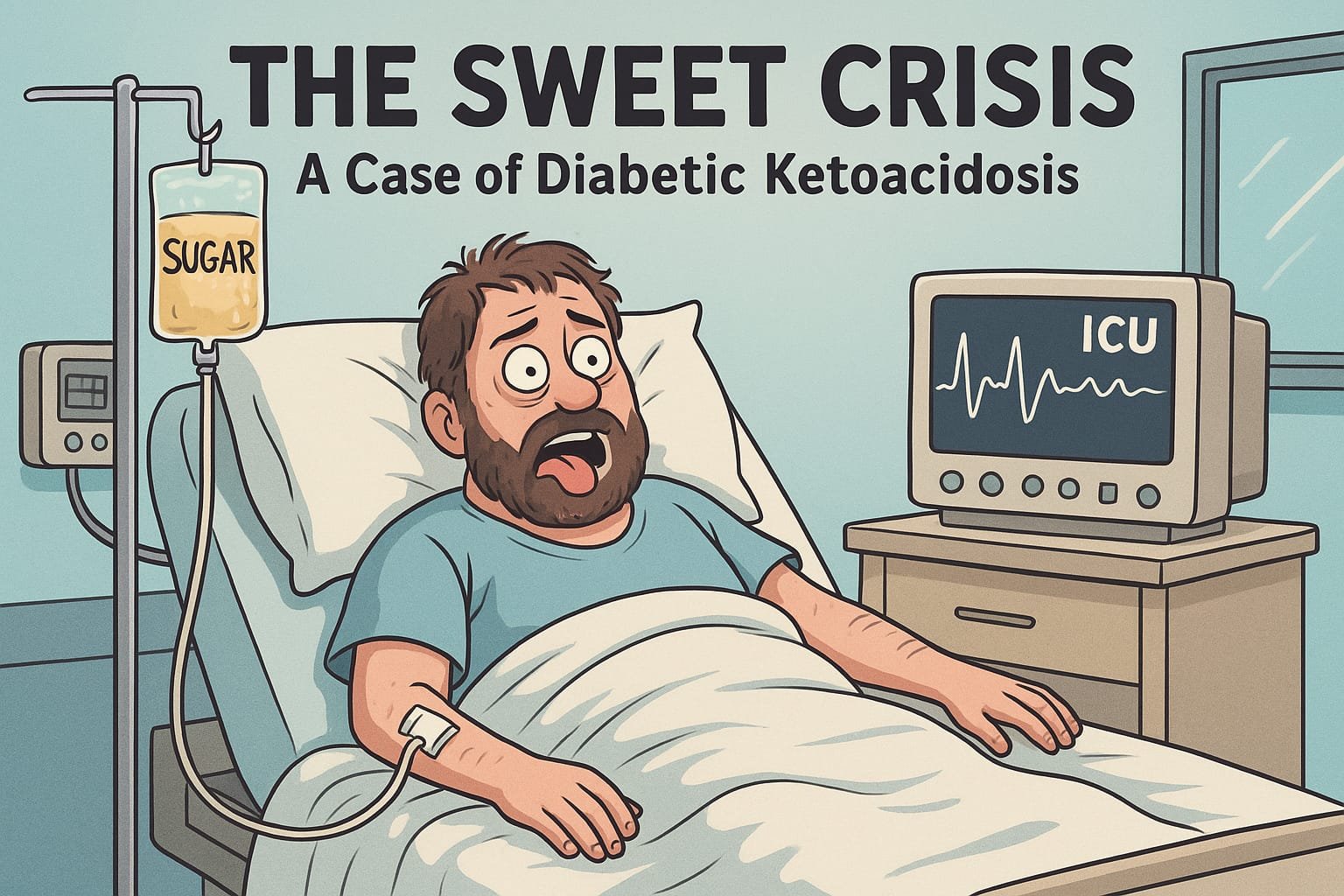
The Sweet Crisis: A Case of Diabetic Ketoacidosis
Case Presentation
A 28-year-old female, known case of Type 1 Diabetes Mellitus, presented to the Emergency Department with abdominal pain, vomiting, and altered sensorium for 1 day.
- History:
- Onset: Gradual, worsening
- Missed insulin doses for 2 days due to fever and poor oral intake
- No recent surgery or steroid intake
- No chest pain or focal neurological deficit
- Family history: Negative
- Examination (on arrival):
- GCS: E3V4M6 = 13/15
- Vitals:
- Temp: 99.8°F
- HR: 128/min (tachycardia)
- BP: 92/60 mmHg (hypotension)
- RR: 32/min with Kussmaul’s respiration
- SpO₂: 96% on room air
- General:
- Dehydrated, fruity odor breath
- Systemic:
- Soft abdomen, no focal neuro deficit, lungs clear
Laboratory Findings
| Parameter | Patient Value | Normal Range |
| RBS | 456 mg/dL | 70–140 mg/dL |
| Arterial pH | 7.12 | 7.35–7.45 |
| HCO₃⁻ | 10 mEq/L | 22–28 mEq/L |
| Anion Gap | 22 | 8–12 |
| Serum Ketones (β-OHB) | Positive | Negative |
| Serum Na⁺ | 132 mEq/L | 135–145 mEq/L |
| Serum K⁺ | 5.4 mEq/L | 3.5–5.0 mEq/L |
| Serum Creatinine | 1.4 mg/dL | 0.6–1.2 mg/dL |
| Serum Osmolality | 312 mOsm/kg | 275–295 mOsm/kg |
| HbA1c | 9.8% | <6.5% |
Diagnosis
Diabetic Ketoacidosis (DKA) — severe, with dehydration and mild altered sensorium.
ICU Management
Day 1: Resuscitation
- Airway/Breathing/Circulation
- O₂ 2 L/min via nasal cannula
- IV access secured, cardiac monitoring started
- Fluid Therapy (cornerstone)
- 1st hr: 0.9% NS, 1 L bolus
- Next hrs: 0.9% NS @ 250–500 mL/hr, titrated to BP & urine output
- Insulin Therapy
- IV Regular Insulin infusion at 0.1 units/kg/hr (started after initial K⁺ checked and fluids given)
- Target: ↓ glucose by 50–70 mg/dL/hr
- Potassium Management
- Initial K⁺ = 5.4 → insulin started without K⁺ supplementation
- Monitored 2-hourly
- Electrolyte & Acid–Base Monitoring
- ABG every 4 hrs
- Na⁺ corrected for hyperglycemia: 132 + (1.6 × [(456–100)/100]) ≈ 138
- Infection Screen (precipitating cause)
- CBC, CXR, urine culture, blood cultures
Day 2: Ongoing ICU Care
- Blood sugar improved: 250 mg/dL
- IV fluids changed to Dextrose 5% + 0.45% NS with KCl supplementation (to prevent hypoglycemia as ketosis resolves)
- Insulin infusion continued at adjusted rate
- K⁺ dropped to 3.4 → 20 mEq KCl added in fluids
- Mental status improving
Day 3: Transition
- Ketones negative, AG normalized
- Shifted to subcutaneous basal-bolus insulin regimen
- Oral feeding restarted
- Diabetes educator counseled patient & family on insulin compliance
Complications to Watch
- Hypoglycemia from insulin
- Hypokalemia from insulin + fluids
- Cerebral edema (especially in children)
- Infections as precipitating factor
Key Learning Points
- DKA = Hyperglycemia + High AG Metabolic Acidosis + Ketosis
- Fluid replacement first, insulin second (after checking K⁺)
- Always monitor K⁺, glucose, and acid–base regularly
- Search for precipitating causes (infection, missed insulin, MI, stroke)
Short Case Story (for memory)
Imagine:
A young woman with Type 1 DM misses her insulin because she’s unwell with fever. She lands in ICU with fruity breath, deep Kussmaul breathing, and hypotension. Labs scream pH 7.12, HCO₃⁻ 10, glucose 456, AG 22.
You rush: NS first, insulin drip, watch potassium. Within 48 hrs, her acidosis resolves, she walks out educated and determined never to skip insulin again.
Quick Q&A
- Qus: What is the most important first step in DKA management?
Ans: Fluid resuscitation (0.9% NS) before insulin. - Qus. At what glucose level do you add dextrose to fluids during insulin infusion?
Ans: When glucose <200–250 mg/dL but acidosis still present. - Qus. What is the most feared complication of rapid correction in DKA?
Ans: Cerebral edema (especially in children/adolescents).